

Author Archives: gsimpson2481

Emma’s Pedestal–World-Widening Welcome

lady-liberty-shamed

If President Trump has nightmares, Emma Lazarus stars in them.

Back in 2003, I wrote about certain widely held norms of American patriotism. President George W. Bush’s new imperialist minions had attacked the patriotism of millions of citizens, myself included, who had criticized the Invasion of Iraq as an unjust war but that the President had publicly sworn was “to disarm Iraq of weapons of mass destruction.”

I began this writing project by reflecting on the self-interrogating nature of American patriotism that Francis Scott Key had woven deeply into the first verse of “The Star-Spangled Banner.” I then turned to Abraham Lincoln followed by Emma Lazarus. I’m still shocked that what I wrote 14 years ago about Emma’s contribution to normative patriotism remains ever-so pertinent today. I had titled the Lincoln section “Lincoln’s Memorial—Equality, Hope, Repentance” and Emma’s “Lazarus’s Pedestal—World-Widening Welcome. Here it is:

Twenty years after Lincoln remade America’s normative patriotism, a thirty-four-year-old, aristocratic Jewish-American woman picked up the Lincoln’s hope-filled “un-finished work” and poetically enlarged our patriotism’s normative capacity. Emma Lazarus, already a well-known poet by 1883, wrote her famous sonnet, The New Colossus, for an art auction to raise funds for the pedestal that now supports the Statue of Liberty.

Give me your tired, your poor,
Your huddled masses yearning to breathe free.1

Another score of years would pass—actually, sixteen years after she died—before Emma’s sonnet, which had already captured the American patriotic imagination, was engraved on Liberty’s pedestal in 1903. Before Emma had died, James Russell Lowell had written her that “your sonnet gives its subject a raison d’etre.”

Indeed, by 1903 Emma had poetically moved American normative patriotism beyond the wide-spread nativist proclivity for a single hegemonic race, ethnicity, class, and gender. American nativism had begun already in the 1850s with campaigns to restrict immigration and naturalization. American nativist culture and politics had its roots going back to Jean-Jacques Rousseau’s 18th-century politics of aristocratic republicanism. In the early years of the 20th century Theodore Roosevelt’s triumphalism again re-kindled American nativism and it continues to be a force up to the present.2

Already in the Civil War post-bellum era of the nineteenth century, nativism had threatened to subvert Lincoln’s re-making of normative patriotism around equality. American nativism has found a home not only in the South’s Jim Crow, and in the New Jim Crow, but in various expressions and to various degrees throughout American political culture. The notion of an American “melting pot,” of course, rhetorically participates in nativist proclivities.

Lazarus had learned the nativist sting in the anti-Semitism she experienced from her earliest years to her last. She also understood the breadth of nativism and the threat it posed to the whither of normative patriotism. No wonder she, an heir of Lincoln’s remade patriotism of equality, began her sonnet with a repentant refusal, a clarion “Not…”!

Not like the brazen giant of Greek fame,
With conquering limbs astride from land to land;

America’s fame is not to be that. With personal experience as pedagogue, Emma prophesized what she knew. Conquering had never been confined to military might alone. It happens economically; it happens culturally; and in these ways, it happens most craftily. Listen.

“Keep, ancient lands, your storied pomp!” cries she
With silent lips. “Give me your tired, . . .

She reserves her most poignant criticism for the cultural “pomp” that had formed the pedestal for the entire edifice of aristocratic economy and culture upon which American nativism, upon which Western civilization through the centuries, had regularly built. Empire and its colonial aspirations have, from of old, stood sturdily upon such pomp. So has the quest for American exceptionalism, for American “greatness.” Emma bids us turn repentantly away from this temptation.

From this “Mother of Exiles,” however, “from her beacon-hand glows world-wide welcome.” Lazarus generates a pluralist hospitality of the tired, the poor, the huddled masses that takes its place within the normative constellation of American patriotism. At the dawn of the 20th century Emma dedicated normative patriotism, continually threatened by nativist proclivities, to that last “great task remaining before us,” as Lincoln had recorded it, “that government of the people, by the people, for the people, shall not perish from the earth.” This is the beacon path beyond so-called American “greatness” toward genuine American goodness.3

In the half century after Lazarus, American patriots would travel the world engaging justifiably in two world wars in order that such government, normed by worldwide welcome, would not perish from the earth. Nativism, nevertheless, would perdure, even flourish, here at home. It fell to another thirty-four-year-old American, this time to an African American pastor with a dream, to lead the unfinished work of hope against America’s persistent proclivity toward nativist patriotism.

  1. For the full text of the famous poem, for an excellent resource for Emma Lazarus’s life, and for a brief and competent critical analysis of her poetic contribution to American public life, see http://www.jwa.org/exhibits/lazarus/ (accessed May, 13, 2003).
  2. See Michael Walzer’s analysis of nativism and its different manifestations and of Rousseauian republicanism in “What Does It Mean to Be an ‘American’?” in The American Intellectual Tradition, ed. David Hollinger and Charles Capper, 2 vols. (New York: Oxford University Press, 1993) 2:391-393. For a brief critical analysis of classic republicanism, see Gary M. Simpson, Critical Social Theory: Political Reason, Civil Society, and Christian Imagination (Minneapolis: Fortress, 2002) 115-118.
  3. For the long debate between American goodness and greatness see Robert Bellah, et al., The Good Society (New York: Vintage, 1991).
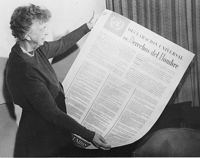
Dear President Obama, Eleanor has helped U.S. Presidents before . . .

Dear President Obama,

Eleanor Roosevelt has helped U.S. presidents before. She can do so again. But beware! She was always an interruptive person in whatever environment she inhabited. Each evening, for instance, in her bedtime prayer she would interrupt God Almighty and plead for divine interruption, fully aware, and even expecting, that the one she addressed as “Our Father” might very well include her personally within God’s Trinitarian work of bringing about “a world made new,” which she pleaded for.

Mr. President, you might suppose that God had finally solidified Eleanor’s interruptive reputation for good when in 1948 she midwifed The Universal Declaration of Human Rights to its completion (http://www.un.org/en/documents/udhr/). Eleanor & UDHR spanish vers.     I say, “for good,” as a double entendre. First, after 1948, no one could ever again deny the for-good difference she had made toward “a world made new.” Her long life lived resiliently against the grain of various dominant cultural, legal, and sociopolitical injustices and oppressions had mattered, and mattered immensely. Second, as you likely know Mr. President, after 1948 people have naturally thought that with the Universal Declaration her contribution toward the human rights regime had reached its zenith. That is, that the Universal Declaration had finalized her reputation once and for all—“for good,” in other words.

But, Mr. President, it’s not likely that Eleanor’s for-good difference has run its course. Over the next few weeks I’d like to share with you how her leadership on the the Universal Declaration has pertinence for two of the most vexing issues that you are now facing. First, Mr. President, Eleanor Roosevelt can help you with ISIS. That’s right, Mr. President, Eleanor can help you with the ISIS crisis. . . . Second, Mr. President, Eleanor can help you with the world-wide political refugee/economic migration crisis. Yup, Mr. President, Eleanor can help you, and here’s how. . . .

Dear President Obama, Eleanor has helped U.S. Presidents before

Dear President Obama,

Eleanor Roosevelt has helped U.S. presidents before. She can do so again. But beware! She was always an interruptive person in whatever environment she inhabited. Each evening, for instance, in her bedtime prayer she would interrupt God Almighty and plead for divine interruption, fully aware, and even expecting, that the one she addressed as “Our Father” might very well include her personally within God’s Trinitarian work of bringing about “a world made new,” which she pleaded for.

Mr. President, you might suppose that God had finally solidified Eleanor’s interruptive reputation for good when in 1948 she midwifed The Universal Declaration of Human Rights to its completion (http://www.un.org/en/documents/udhr/). Eleanor & UDHR spanish vers.     I say, “for good,” as a double entendre. First, after 1948, no one could ever again deny the for-good dif- ference she had made toward “a world made new.” Her long life lived resiliently against the grain of various dominant cultural, legal, and sociopolitical injustices and oppressions had mattered, and mattered immensely. Second, as you likely know Mr. President, after 1948 people have naturally thought that with the Universal Declaration her contribution to- ward the human rights regime had reached its zenith. That is, that the Universal Declaration had finalized her reputation once and for all—“for good,” in other words.

But, Mr. President, it’s not likely that Eleanor’s for-good difference has run its course. Over the next few weeks I’d like to share with you how her leadership on the the Universal Declaration has pertinence for one of the most vexing issues that you are now facing. Mr. President, Eleanor Roosevelt can help you with ISIS. That’s right, Mr. President, Eleanor can help you with the ISIS crisis. . . .

Social Media and Dietrich Bonhoeffer

This week’s question for our course is, “How are social media changing the ecology of our communities of faith?” Well, I have absolutely no doubt that they are; and yet at this point in time I have little real insight into the more adaptive ways that change is emerging because of social media. I’m wondering if my imagination, while considering this question, is still too colonized by a penchant for thinking change as technical change.

It was reading student blogs that got me thinking about Dietrich Bonhoeffer of all people, which got me wondering whether or not I was thinking about the word “changing” in our question through the concept of technical or adaptive change. (I’ve been teaching a course on Bonhoeffer for a dozen years, been researching and writing on him over the last 6 years or so, and am now working on a book on Bonhoeffer and Missional Church.) Here’s how Bonhoeffer’s got me wondering.

At the age of 21–yup, 21–Dietrich Bonhoeffer wrote his doctoral dissertation on Sanctorum Communio: A Theological Study of the Sociology of the Church. I’m starting to think about our course in a similar way, as a theological study of the sociology, or better, of the sociality of the church. Bonhoeffer used all of the sociological tools that were available to him in the early 20th century.

What drew him to this study was his own experience of “church-lite,” as I like to call it. When Dietrich was 12 his second oldest brother, Walter, was killed in World War I. Dietrich was very distraught. The church that he was baptized into and that he belonged to was missing-in-action for him. There was no church bearing the burden of his grief with him (Gal. 6:2). In his dissertation, and throughout his life he called this church-lite experience “bourgeois Protestantism,” and he discovered that this was the normative experience of people of his day. Bourgeois Protestantism was fraught with atomistic individualism, middle-and-upper-class concerns with little attention to the problems or interests of the working classes and the realities of the rapidly increasing numbers of poor and unemployed people. It was a Protestantism focused on thin rituals around the bare minimalist lifecycle concerns of hatching, matching, and dispatching.

When he was 18, Dietrich and his oldest brother, Karl, traveled to Rome. Day after day Dietrich kept going back to St. Peter’s Basilica and to the Vatican. He was captivated by the gravity architecturally expressed by the Basilica but troubled by the hierarchy embedded in a pre-Vatican II Vatican.

Bonhoeffer’s dissertation tried to open up an innovative, adaptive space for an ecclesial “life together” somewhere in between the thin atomistic individualism of bourgeois Protestantism and the thick hierarchical holism of Vatican Roman Catholicism. Karl Barth once called Bonhoeffer’s dissertation “a theological miracle.” Indeed, one could view Dietrich’s entire life, and even his martyrdom, as a living search for such a church where christologically bearing one another’s burdens was the deep ecclesial reality. The real miracle was that Bonhoeffer even attempted to discover such  a social space, such an ecclesial sociality of Christ in the power of the Holy Spirit to the glory of the Father.

Might thinking our course in such a light add some martyrological boldness to our undertaking together?

aka SweetLips or “What’s in a sobriquet?”

There were two or three of us. Actually there were about four or five of us. White guys, that is. We were among the 30 or so guys that regularly played noon pick-up basketball at Alameda (CA) Community College back in the late 1970s. Just about everybody else was African Americans with a few Hispanic and Asian guys as well.

“White guys can’t jump,” was the commonplace, and relatively speaking, that was me. But, I had a good set of hands, and I could also really really shoot from long distance. Following the fledgling American Basketball Association, we had just put in a three-point line in our pick-up games. After I made four or five three-pointers in one game, one of my black friends shouted out, “you can’t jump but you sure got radar.”

From that day on “Radar” was my nickname, my “sobriquet,” to use the old fancy French-derived word.

Martin Luther once gushed wildly about Jesus’ “sweet lips,” leading to my blog’s sobriquet. Next time I’ll say more about why Luther nicknamed Jesus “SweetLips.”